

Family Visas · Subclass 838 & Subclass 114
Aged Dependent Relative Visa Consultant in Australia
Bring an elderly, single relative who depends on you to live in Australia permanently. Our registered migration agent assesses eligibility for the onshore subclass 838 and the offshore subclass 114, prepares the dependency evidence and lodges the application for you.
- Honest eligibility check before you pay any government fee.
- Clear advice on cost, queue time and alternative visas.
- Application prepared by a Registered Migration Agent (MARN 2418548).
- Permanent residency
- Onshore: Subclass 838
- Offshore: Subclass 114
Speak to an Aged Dependent Visa Consultant
Share a few details and our team will contact you about your relative's options.
What Is the Aged Dependent Relative Visa in Australia (Subclass 838 and 114)?
The Aged Dependent Relative visa lets an older person with no spouse or partner live in Australia permanently, close to the family member who already supports them. It is part of Australia's Other Family visa stream and comes in two subclasses that give the same permanent visa.
Aged Dependent Relative visa subclass 838 is for people who are already in Australia. Aged Dependent Relative visa subclass 114 is for people who are outside Australia. The difference is where you are when you apply and when the visa is decided.
It suits a widowed, divorced or never-married parent, grandparent, aunt, uncle or sibling whose living costs are paid by a relative settled in Australia.
Check My Eligibility
Benefits of the Aged Dependent Relative Visa for Elderly Family Members
Subclass 838 and subclass 114 are both permanent visas. Once granted, your relative has the same rights as any other Australian permanent resident.
Stay Permanently
Live in Australia indefinitely with the family member who supports you. There is no temporary stage to pass first.
Work and Study
Visa holders can work and study in Australia without restrictions, the same as other permanent residents.
Access to Medicare
Enrol in Medicare, Australia's public healthcare scheme, which lowers the cost of doctors, hospitals and medicines.
Travel for 5 Years
Travel to and from Australia freely for five years from grant. After that, a Resident Return visa keeps the travel facility going.
Sponsor Relatives
As a permanent resident, you can sponsor eligible family members to come to Australia, subject to the rules of each visa.
Pathway to Citizenship
Apply for Australian citizenship once you meet the residence and other eligibility requirements.
Aged Dependent Relative Visa Requirements and Eligibility for Subclass 838 and 114
Having family in Australia and being the right age is not enough on its own. The applicant, the relationship and the sponsor are each assessed, and the requirements must be met both when you apply and when the visa is decided.
Who Can Apply for an Aged Dependent Relative Visa
- Old enough to receive the Australian Age Pension, currently 67.
- Single: never married, widowed, divorced or permanently separated, with no de facto partner.
- Has relied on an Australian relative for financial support for a reasonable period, usually the past three years, and still does.
- Meets Australia's health and character requirements.
What Counts as Financial Dependency
You rely on your relative for basic living needs, more than on anyone else or on your own income:
- Food and day-to-day expenses.
- Housing or rent.
- Clothing and other essentials.
- Regular, traceable support such as bank transfers.
Who Can Sponsor an Aged Dependent Relative
- Your child, parent, sibling, grandchild, aunt, uncle, niece or nephew (step relatives included).
- An Australian citizen, Australian permanent resident or eligible New Zealand citizen.
- Aged 18 or over and settled in Australia, usually living here lawfully for about two years.
- In some cases the relative's spouse or de facto partner can sponsor, if they live together.
Assurance of Support for Visa 838 and 114
- A legal promise, given through Services Australia, to support you so you do not rely on government payments.
- The assurer must pass an income test.
- A bank guarantee is held for the assurance period, currently AUD 5,000 for one adult over four years.
- The assurer does not have to be the sponsor.
Not sure if your relative qualifies?
Send us their age, marital status and how they are supported. We will tell you where they stand.
Subclass 838 vs Subclass 114: Onshore or Offshore Aged Dependent Relative Visa?
Both lead to the same permanent visa and share the same eligibility rules, costs and queue. Your location decides which one you apply for.
| Subclass 838 (Onshore) | Subclass 114 (Offshore) | |
|---|---|---|
| Where you apply | In Australia when you apply and when the visa is granted. | Outside Australia when you apply and when the visa is granted. |
| Your current visa | Matters. A "No Further Stay" condition (8503) or not holding a substantive visa can stop an onshore application. | No Australian visa is needed to lodge. |
| While you wait | A bridging visa is usually granted so you can stay lawfully during processing. Work and travel conditions vary. | No bridging visa. You wait overseas and can visit on a separate visitor visa if one is granted. |
| Visa outcome | Permanent residency. | Permanent residency. |
| How to lodge | Paper application: Form 47OF with sponsorship Form 40. | Paper application: Form 47OF with sponsorship Form 40. |
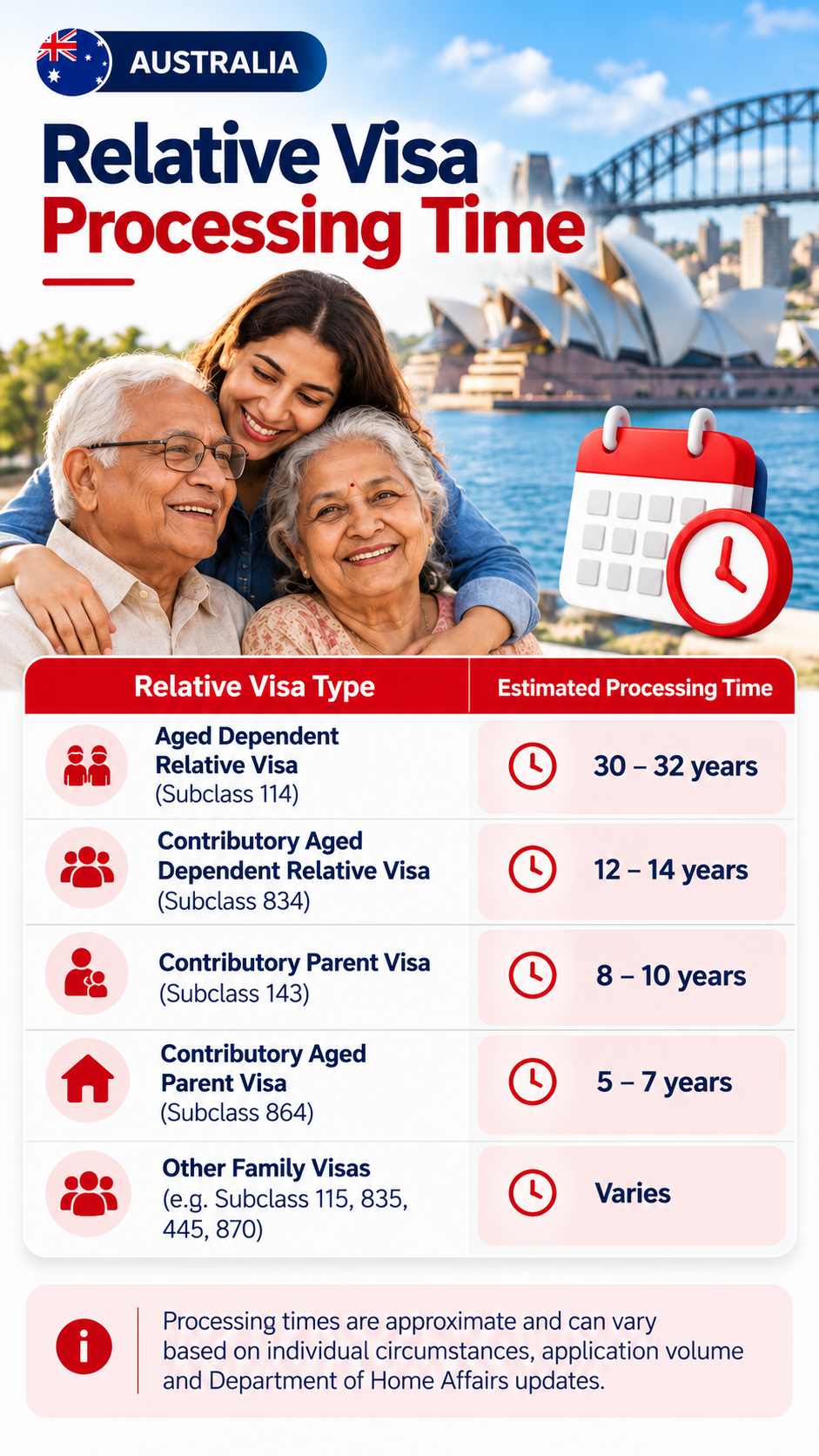
Aged Dependent Relative Visa Processing Time: How Long Do 838 and 114 Take?
Aged Dependent Relative visas are capped and queued. Only a small number can be granted each migration year, and applications wait in line by queue date.
~5 weeksto acknowledge a new application
30 June 2013queue date now being released for final processing
~26 yearsestimated wait for an application lodged today
Department of Home Affairs figures as at 31 August 2026. The estimate is not a guarantee and is usually updated once a year.
Why the wait is so long, and what you can do
- Demand is far higher than the places available each year.
- Your queue date is set once the core criteria are met, so a complete first application matters.
- An onshore subclass 838 applicant can usually stay in Australia on a bridging visa while waiting.
- Other visas, such as Parent visas, may be faster for some families.
Aged Dependent Relative Visa Cost and Fees in Australia (2026–27)
The government visa application charge is the same for subclass 838 and subclass 114, and is paid in two instalments.
| Applicant | First instalment (when you apply) | Second instalment (before grant) |
|---|---|---|
| Main applicant | AUD 6,600 | AUD 2,065 |
| Additional applicant, 18 or over | AUD 3,300 | AUD 2,065 |
| Additional applicant, under 18 | AUD 1,655 | AUD 2,065 |
| Total for one applicant | AUD 8,665 in government charges | |
Other Costs to Budget For
- Health examinations and police certificates.
- Certified translations of documents not in English.
- Assurance of Support bank guarantee, currently AUD 5,000 for one adult.
- Professional fees for a migration agent.
When Each Payment Is Due
- The first instalment is paid when the application is lodged.
- The second instalment is requested only when your application reaches final processing.
- Government charges are generally not refunded if the visa is refused.
- Charges are reviewed by Home Affairs each year on 1 July.
Government charges effective from 1 July 2026. GIEC Global gives you a written fee quote before any work starts.
Want a clear cost breakdown for your family?
We will set out government charges and our fees in writing, with no surprises.
How to Apply for an Aged Dependent Relative Visa 838 or 114, Step by Step
The process is the same for both subclasses, apart from where the applicant is located.
Check Eligibility
Confirm age, single status, the family relationship and the sponsor's status. For subclass 838, check that your current visa allows an onshore application.
Build Dependency Evidence
Gather around three years of records showing your relative pays for your basic living costs, plus evidence of your own income and assets.
Lodge the Paper Application
Submit Form 47OF and sponsorship Form 40 with supporting documents and the first instalment. These visas cannot be lodged online.
Receive a Queue Date
Home Affairs assesses the core criteria. Applications that meet them get a queue date. Those that do not are refused.
Wait in the Queue
Keep your details current and tell Home Affairs about any change, such as marriage, a change in support or a new address.
Final Processing and Grant
When your queue date is reached, complete health and police checks, arrange the Assurance of Support and pay the second instalment.
Documents Required for an Aged Dependent Relative Visa Application
Strong documents at lodgement are what get an application into the queue. Documents not in English need certified translations.
Applicant
Identity and Marital Status
- Passport, birth certificate and national ID.
- Divorce certificate, spouse's death certificate or a statutory declaration of single status.
- For subclass 838, details of current and previous Australian visas.
Relationship
Family Link to the Sponsor
- Birth and marriage certificates that connect you to your relative.
- Family registers or household records, where issued.
- Evidence of name changes, if any.
Dependency
Proof of Financial Support
- Bank statements and money transfer receipts covering about three years.
- Rent, utility, medical and grocery bills paid by your relative.
- Your own pension, income, savings and property records.
Sponsor
Sponsor's Documents
- Australian passport, citizenship certificate or permanent visa evidence.
- Proof of living in Australia, such as a lease, rates notice or tax assessments.
- Completed and signed Form 40.
Common Reasons an Aged Dependent Relative Visa Is Refused
This is one of the harder family visas to get right, and the first instalment is generally not refunded after a refusal. These are the problems we check for before lodging.
Dependency Not Proven
Occasional gifts or a few recent transfers do not show reliance for basic needs over a reasonable period.
Applicant Can Support Themselves
A pension, rental income, savings or property overseas can show the applicant does not need the relative's support.
Supported by Someone Else
If other children or relatives contribute equally or more, dependency on the Australian relative is hard to establish.
Not Single
A spouse or de facto partner at application or at decision, even many years later in the queue, ends eligibility.
Sponsor Not Settled
A sponsor who has only recently arrived, or who lives mostly overseas, may not count as settled in Australia.
Invalid Onshore Application
For subclass 838, a "No Further Stay" condition or the wrong visa status can make the application invalid.
Aged Dependent Relative Visa vs Parent Visa: Which Is Better for Your Parent?
Many people asking about an "aged dependent visa" are trying to bring a parent to Australia. A parent may qualify under either pathway, so both should be compared.
| Aged Dependent Relative (838 / 114) | Parent and Contributory Parent visas | |
|---|---|---|
| Who it covers | Parents and other relatives, such as grandparents, aunts, uncles and siblings. | Parents of a settled Australian citizen, permanent resident or eligible New Zealand citizen. |
| Main test | Financial dependency on the Australian relative. | Balance of Family test: at least half of the parent's children live permanently in Australia. |
| Marital status | Must be single. | Married parents can apply together. |
| Cost and speed | Lower government charge, very long queue. | Contributory options cost much more but are generally processed sooner. |
Compare your family's visa options
We will check the Aged Dependent Relative, Parent and visitor visa pathways side by side.
How GIEC Global's Aged Dependent Visa Consultants Can Help You
With a wait this long, the application has to be right the first time. Here is what our team does for you from the first call to the final decision.
Eligibility Assessment
We review age, marital status, the family relationship and the sponsor's status, and tell you plainly if the visa is not a fit.
Dependency Evidence Review
We go through bank records, transfers and living costs and show you which gaps need to be filled before lodging.
Onshore Visa Check
For subclass 838, we check your current visa and its conditions so the application is valid when it is lodged.
Application Preparation
We prepare Form 47OF, sponsorship Form 40 and the supporting documents, and lodge the paper application.
Support During the Queue
We respond to Home Affairs requests and update your file when your address, sponsor or circumstances change.
Alternative Pathways
Where another visa suits your family better, we explain the options, costs and timeframes so you can decide.
Why Choose GIEC Global as Your Aged Dependent Relative Visa Consultant
Migration advice in Australia can only be given by a registered migration agent or a legal practitioner. When you work with us, you know who is responsible for your case.
- Registered Migration Agent. Your matter is handled by Suman Prem, MARN 2418548, which you can verify on the public OMARA register.
- Bound by the Code of Conduct. Registered agents must act honestly, keep your information confidential and give you a frank assessment of your chances.
- Written agreement and fees. You receive a service agreement and fee quote before work begins.
- No guaranteed outcomes. Only the Department of Home Affairs can grant a visa. We will never promise a result or a faster queue.
- Family visa focus. We assist families with partner, parent, child and other family visa applications across Melbourne, Sydney and Perth.

Aged Dependent Relative Visa Australia: Frequently Asked Questions
What is the difference between visa 838 and visa 114?
They are the same permanent visa with different location rules. Subclass 838 is for applicants who are in Australia when they apply and when the visa is granted. Subclass 114 is for applicants who are outside Australia at both points.
How old do I need to be for an Aged Dependent Relative visa?
You must be old enough to qualify for the Australian Age Pension, which is currently 67. You do not need to be receiving the pension.
Can a married person apply for an Aged Dependent Relative visa?
No. The applicant must have no spouse or de facto partner. People who have never married, are widowed, divorced or permanently separated can apply.
How much does the Aged Dependent Relative visa cost?
From 1 July 2026 the government charge for the main applicant is AUD 6,600 at lodgement and AUD 2,065 before grant, a total of AUD 8,665. Health checks, police certificates, translations, the Assurance of Support bank guarantee and professional fees are extra.
How long does the Aged Dependent Relative visa take?
Home Affairs estimates about 26 years for a new application, because only a limited number of these visas are granted each year. As at 31 August 2026, applications with a queue date up to 30 June 2013 were being released for final processing.
Can I stay in Australia while my subclass 838 application is waiting?
Usually yes. A valid onshore application normally comes with a bridging visa that lets you stay lawfully until a decision is made. Check its work and travel conditions before making plans, and do not leave Australia without the right travel permission.
Can I apply for visa 838 while on a visitor visa?
It depends on your visitor visa. If it carries a "No Further Stay" condition (8503), you generally cannot lodge another visa application in Australia unless that condition is waived. Have your visa conditions checked before you apply.
Is the Aged Dependent Relative visa the same as a Parent visa?
No. A Parent visa is based on being the parent of an Australian and uses the Balance of Family test. The Aged Dependent Relative visa is based on financial dependency, has no Balance of Family test and covers a wider group of relatives.
Will I get the Age Pension once the visa is granted?
Not straight away. The Age Pension generally requires ten years of Australian residence, so your relative and your Assurance of Support remain your main financial support in the early years.
What happens if my circumstances change while I am in the queue?
You must still meet the requirements when the visa is decided. Marrying, starting a de facto relationship, no longer being dependent, or your sponsor leaving Australia can each lead to refusal, so tell Home Affairs about changes promptly.
Do I need a migration agent for an Aged Dependent Relative visa?
It is not compulsory. Many families use a registered migration agent because the dependency rules are technical, the application is paper-based and a refusal usually means losing the first instalment.
Talk to an Aged Dependent Relative Visa Consultant
GIEC Global Australia · Registered Migration Agent MARN 2418548