

Subclass 101, 802 & Adoption 102
Child Visa Australia Consultants for Subclass 101 (Offshore) & 802 (Onshore) Visas
Being apart from your child is the hardest part of migrating. GIEC Global's child visa consultants help Australian citizens, permanent residents and eligible New Zealand citizens bring a dependent or adopted child to Australia permanently, whether your child is overseas today or already here on a temporary visa.
- Clear advice on whether the 101 visa, the 802 visa or the adoption visa 102 fits your family
- Document checklist, sponsorship forms and lodgement handled for you
- Honest guidance on child visa cost and processing time before you pay anything
PermanentPR from the day of grant
AUD 4,040Government charge, main applicant
~20 monthsMedian, onshore 802 visa
~26 monthsMedian, offshore 101 visa
Free Child Visa AssessmentTell us about your child and we'll call you back with the right pathway.
What Is a Child Visa in Australia and Who Can Apply?
The child visa Australia offers is a permanent visa that lets a dependent child live with their parent in Australia indefinitely. It is designed for children who were not included in a parent's original visa, were born or stayed overseas while a parent settled here, or arrived later on a temporary visa.
It comes in two versions with the same rights and the same fee. The subclass 101 visa is the offshore child visa: your child must be outside Australia when the application is lodged and when it is decided. The subclass 802 visa is the onshore child visa: your child must be in Australia at both of those points.
The parent, or the parent's partner, acts as sponsor and must be an Australian citizen, permanent resident or eligible New Zealand citizen. The child is the applicant, and every child needs an individual application. Children adopted overseas often need the separate Adoption visa (subclass 102) instead.
Lodging under the wrong subclass, or while your child is in the wrong country, makes the application invalid and the charge is not refunded. That first decision is where our child visa consultants start.
Book a Consultation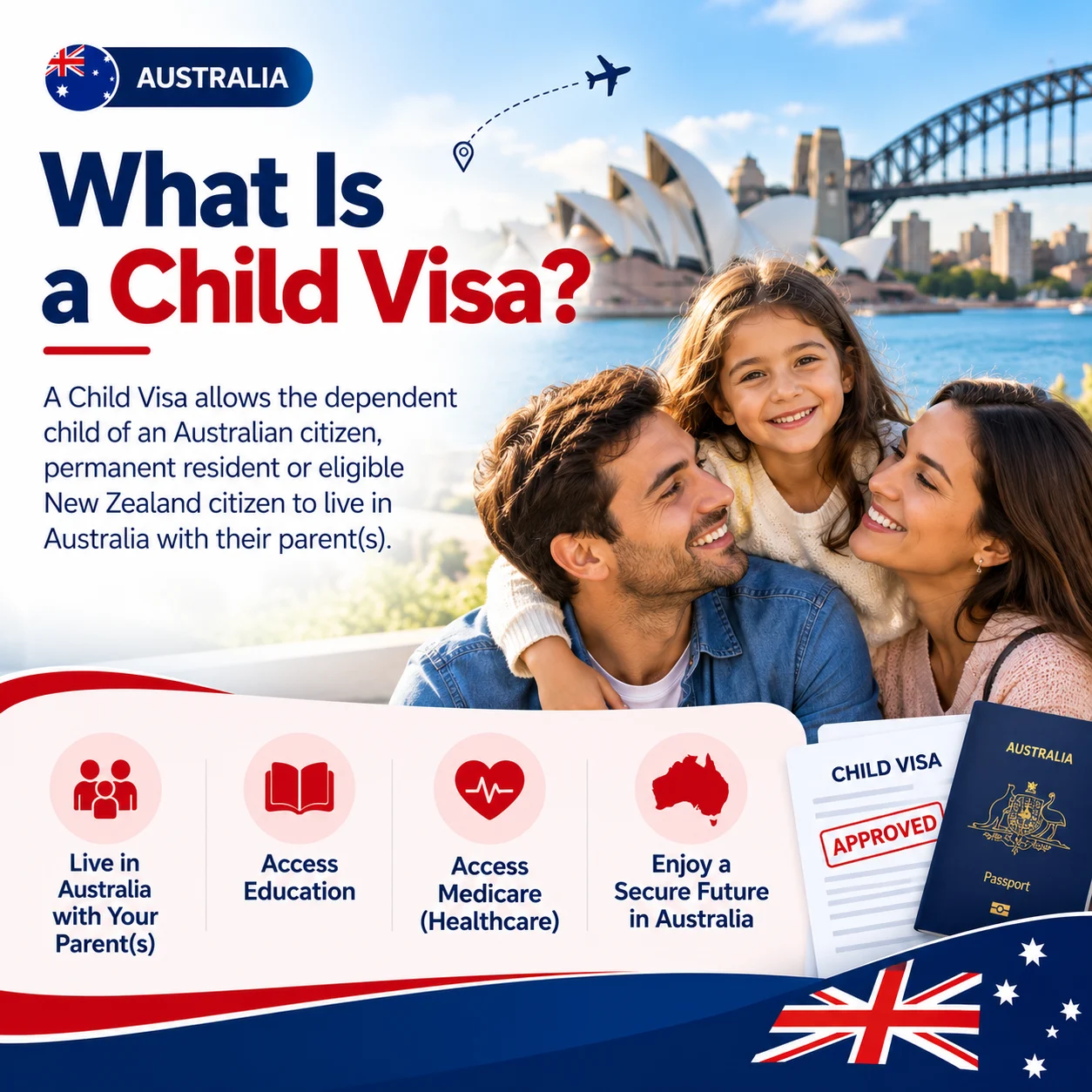
101 Visa vs 802 Visa: Difference Between the Offshore and Onshore Child Visa
Both grant permanent residency. What changes is where your child waits, how they travel during processing and how long a decision usually takes.
| Comparison | Subclass 101 (Offshore) | Subclass 802 (Onshore) |
|---|---|---|
| Where the child must be | Outside Australia at lodgement and at decision | In Australia at lodgement and at decision |
| Typical situation | Child stayed overseas when the parent migrated, or was not included in the parent's original visa | Child is already in Australia on a visitor, student or other temporary visa |
| While you wait | Child waits overseas. Short visits may be possible on a separate visitor visa | Child usually receives a bridging visa and stays with you in Australia |
| Travel during processing | Generally unrestricted, but must be offshore for the decision | Usually needs a Bridging Visa B before leaving Australia |
| Recent median processing | About 26 months | About 20 months |
| Government charge | AUD 4,040 | AUD 4,040 |
| Watch out for | Child entering Australia close to decision time | "No Further Stay" (8503) condition on the current visa |
Processing figures reflect Department of Home Affairs data as at August 2026 and change monthly.
When the offshore 101 visa makes sense
Your child lives overseas with the other parent or relatives, is settled in school there, or holds no visa that would let them enter Australia and apply. There is no bridging visa to manage and no risk of breaching a visa condition while waiting.
When the onshore 802 visa makes sense
Your child is already in Australia lawfully and their current visa allows a further application. The family stays together during processing, and recent decisions have been faster than for offshore cases.
Child Visa Australia Requirements for Subclass 101 and 802
The Department assesses the child, the sponsoring parent and the relationship between them. These are the child visa requirements we check in your first consultation.
Requirements for the child
- Is the biological child, adopted child or, in limited cases, step-child of the sponsoring parent
- Meets the dependent child definition and age limit explained below
- Is single: not married, engaged or in a de facto relationship
- Meets Australian health and character requirements
- Has no outstanding debt to the Australian Government
Requirements for the sponsor
- Is an Australian citizen, Australian permanent resident or eligible New Zealand citizen
- Is the child's parent, or the parent's spouse or de facto partner
- Is generally aged 18 or over and willing to support the child after arrival
- Can show parental responsibility, or written consent from anyone else with a legal say over where the child lives
Extra rules for the onshore 802 visa
- Child is physically in Australia when you lodge
- Child generally holds a substantive visa without a "No Further Stay" condition, unless a waiver has been granted
- A previous visa refusal or cancellation in Australia can limit eligibility
- Child stays lawful on a bridging visa until the decision
Subclass 101 and 802 visa document checklist
- Full birth certificate naming both parents, plus passport
- Sponsor's proof of citizenship or permanent residency
- Custody orders or consent forms for children under 18
- Enrolment and financial dependency evidence for children 18 and over
- Police certificates for applicants aged 16 or older, and health examinations
- Certified English translations of any document in another language
Dependent Child Visa Australia Age Limit: Who Counts as a Dependent Child?
Age alone does not decide eligibility. The Department looks at whether the child genuinely relies on the parent, and the evidence changes with each age group.
Under 18
The most straightforward group. The focus is on proving the parent-child relationship and showing that everyone with parental responsibility agrees to the child living in Australia.
18 to 24
The child must be studying full time and depend on the parent for basic needs such as food, housing and clothing. Gaps in study or full-time work usually break the dependency.
Over 18 with a disability
A child who cannot work because of a physical or mental condition may qualify at any age, supported by medical evidence of how the condition affects their capacity to work.
Step-child visa Australia rules
A step-child can apply only in narrow circumstances: generally the child is under 18, the step-parent is no longer the partner of the child's parent, and the step-parent holds a court order giving them legal responsibility. Where the step-parent is still with the child's parent, a different pathway usually applies.
Adopted child visa Australia rules
Whether an adopted child applies for a child visa or the Adoption visa (subclass 102) depends on when the adoption was finalised and the parent's status at that time. The next section explains the 102 visa in detail.
Child Adoption Visa Subclass 102: Requirements, Cost and Processing Time
The Adoption visa (subclass 102) is a permanent visa that lets a child adopted outside Australia come here to live with their adoptive parent. It is an offshore visa: the child must be outside Australia when the application is lodged and when it is decided.
Intercountry adoption
The adoption is arranged with the involvement of an Australian state or territory central adoption authority, through one of Australia's official partner-country programs.
Hague Convention adoption
The adoption was completed between two countries that are party to the Hague Adoption Convention, and was carried out in line with that Convention.
Expatriate adoption
A privately arranged adoption under the law of another country, where the adoptive parent has lived outside Australia for more than 12 months before applying and holds full, permanent parental rights.
Adoption visa 102 requirements
- Child is under 18 when adopted, when the application is lodged and when it is decided
- Sponsor is the adoptive or prospective adoptive parent, and is an Australian citizen, permanent resident or eligible New Zealand citizen
- The adoption fits one of the three recognised routes above
- For expatriate adoptions, the parent did not live overseas to get around Australian adoption rules
- Child meets health requirements, and character requirements if aged 16 or over
- Granting the visa is in the child's best interests
Adoption visa 102 documents
- Child's birth certificate and passport
- Adoption order, or the approval and placement papers if the adoption is still in progress
- Adoption compliance certificate for Hague Convention cases
- Proof of the adoptive parent's overseas residence for expatriate cases
- Consent or relinquishment documents from the birth parents or the overseas authority
- Sponsor's proof of citizenship or permanent residency
| Adoption visa 102 | Detail | Notes |
|---|---|---|
| Visa type | Permanent | Same rights as the 101 and 802 child visas after grant |
| Government charge | AUD 4,040 | Main applicant. Each adopted child needs a separate application |
| Processing time | About 7 months median | 90% of recent applications decided within about 16 months |
| Location | Offshore only | Child must be outside Australia at lodgement and decision |
Charge and processing figures as at August 2026.
Adoption visa 102 or child visa 101: which one?
Not every adopted child needs the 102 visa. Where the adoption was completed before the parent became an Australian citizen or permanent resident, the standard child visa is often the correct subclass. Where the adoption came afterwards, the 102 visa usually applies. We read the adoption order and the timeline before recommending either.
Could your adopted child be a citizen already?
A child adopted under the Hague Convention or a bilateral arrangement may be able to apply for Australian citizenship directly, without needing a visa first. We check this option before any 102 visa is lodged.
Adopting a child from overseas?
Get Adoption Visa Advice
Speak to us before the adoption is finalised. The route you choose decides which visa is open to you.
Benefits of an Australian Child Visa for Subclass 101, 802 and 102 Holders
These are permanent residency visas from the day they are granted, not temporary stays that need renewing.
Stay Indefinitely
Your child can live in Australia with you permanently, with no expiry on their right to remain.
Study in Australia
Enrol in school, TAFE or university as a permanent resident rather than as an international student.
Medicare Access
Enrol in Australia's public healthcare scheme for subsidised medical and hospital care.
Work Rights
Older children can work in Australia without the hour limits attached to student visas.
Travel Freely
Leave and re-enter Australia for five years from grant, then renew the travel facility.
Path to Citizenship
Apply for Australian citizenship once eligible, and sponsor eligible relatives later on.
How Much Does a Child Visa Cost in Australia in 2026?
The 101 visa fee, the 802 visa application fee and the adoption visa 102 fee are identical. The government charge is paid at lodgement and is not refunded if the application is refused or withdrawn.
| Cost item | Amount | Notes |
|---|---|---|
| Main applicant (the child) | AUD 4,040 | Same for subclass 101, 802 and 102 |
| Additional applicant, 18 or over | AUD 2,020 | Only where the child has their own dependent included |
| Additional applicant, under 18 | AUD 1,015 | As above |
| Health examinations | Varies | Paid to the panel clinic, depends on country and age |
| Police certificates | Varies | For applicants 16 and over, from each relevant country |
| Biometrics, translations, certified copies | Varies | Depends on the child's country and documents |
| Professional fees | Quoted upfront | Fixed written quote from GIEC Global after your assessment |
Government charges are current as at August 2026 and are usually revised each 1 July. Reduced charges apply to some Pacific Island and Timor-Leste citizens. Confirm with the Home Affairs Visa Pricing Estimator before lodging.
Child visa cost for two or more children
Siblings cannot share an application. Each child lodges separately and pays the full main-applicant charge, so two children means two charges plus two sets of health and police checks. We lodge sibling files together so they are assessed side by side.
Costs parents often miss
Budget for a Bridging Visa B if an onshore child needs to travel, a visitor visa if an offshore child wants to visit, replacement civil documents and courier fees. In some cases the Department can also ask for an Assurance of Support.
Want an exact figure for your family?
Get a Cost Estimate
We'll total the child visa cost for your case, including health and police checks.
101 Visa and 802 Visa Processing Time in Australia
How long does a child visa take?
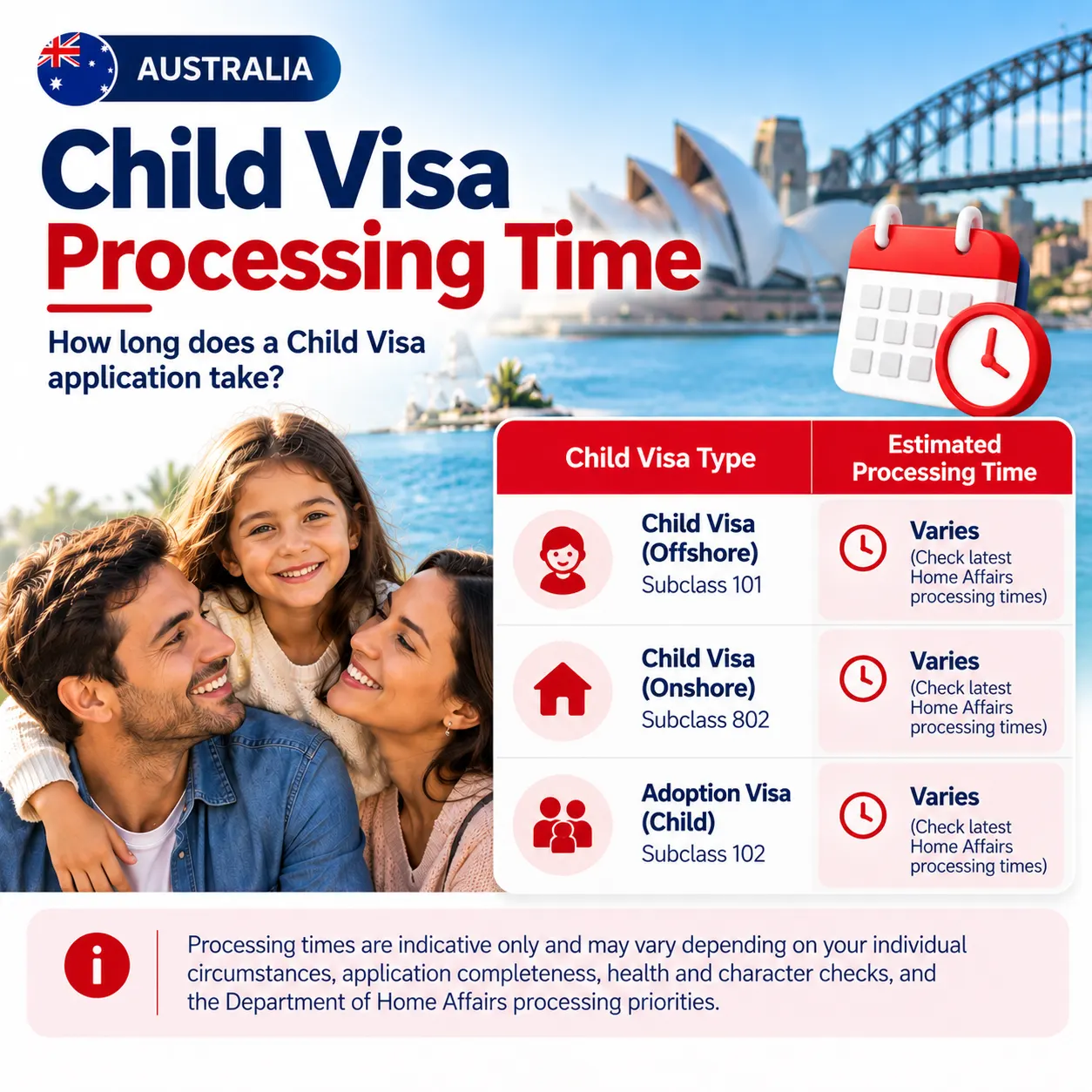
Recent Department of Home Affairs figures (August 2026) show how long decided applications took:
- 802 visa processing time (onshore): half of applications decided within about 20 months, and 90% within about 29 months.
- 101 visa processing time (offshore): half of applications decided within about 26 months, and 90% within about 33 months.
- Adoption visa 102 processing time: half of applications decided within about 7 months, and 90% within about 16 months.
What slows an application down?
- Missing or untranslated birth, custody or adoption documents
- Unclear consent from the child's other parent
- Late health examinations or police certificates
- Slow replies to requests for further information
Can child visa processing be made faster?
There is no paid priority service. The Department can prioritise cases with compelling circumstances, and a complete, decision-ready file avoids the back-and-forth that adds months. These are guide figures, not guarantees.
Start My ApplicationHow to Apply for a Child Visa in Australia Step by Step
Five stages from first call to visa grant.
1
Confirm the right subclass
We check your child's location, age, dependency and current visa conditions to decide between subclass 101 and subclass 802, or another option such as the Adoption visa (102) or Dependent Child visa (445).
2
Gather evidence
Identity, relationship, custody, adoption and dependency documents are collected, translated and certified against a checklist built for your case.
3
Lodge the visa and sponsorship
The child's application and the parent's sponsorship form are lodged together, and the visa application charge is paid.
4
Health, character and biometrics
Your child completes medical examinations, and police checks if aged 16 or over. Onshore applicants are normally granted a bridging visa at this point.
5
Decision and arrival
We respond to any Department requests and tell you the outcome. For a 101 or 102 visa your child then travels to Australia before the first-entry date. For an 802 visa their status changes to permanent resident.
Was your child born overseas to an Australian citizen?
They may qualify for citizenship by descent instead, which is usually quicker and cheaper than a child visa. We check this first.
Bridging Visa and Travel Rules While Your Child Visa Is Processing
With waits of around two years, what your child can do in the meantime matters as much as the application itself.
802 visa bridging visa
A child who lodges a valid onshore application while holding a substantive visa is normally granted a Bridging Visa A. It starts when the current visa ends and keeps the child lawful in Australia until a decision.
Travelling on an 802 application
Leaving Australia on a Bridging Visa A ends it. Your child needs a Bridging Visa B before departure and must be back in Australia, and here on decision day, for the visa to be granted.
Visiting during a 101 application
An offshore child may apply for a visitor visa to see you. It is assessed separately, is not guaranteed, and your child must be outside Australia when the 101 visa is decided.
Common Reasons a Child Visa Is Refused in Australia
Most refusals come down to evidence, not eligibility. These are the issues we see most often when families come to us after a 101 visa or 802 visa has been rejected:
- The child was in the wrong location when the application was lodged or decided
- No consent or court order from the other parent for a child under 18
- Dependency not proven for a child over 18, often because of study gaps or paid work
- The child married, became engaged or entered a de facto relationship during processing
- Birth or adoption records the Department could not verify
- An overseas adoption that does not fit any recognised route for the 102 visa
- Health or character requirements not met, or requests left unanswered
What to do after a child visa refusal
Many refusals carry a right of review at the Administrative Review Tribunal, but the deadline is strict and cannot be extended. Review is not always the best route: in some cases a fresh, stronger application is quicker.
Send us the refusal letter as soon as you receive it and we will tell you which options are open and how long you have.
Get Refusal AdviceOther Child Visa Options: Dependent Child Visa 445 and Orphan Relative Visa
Subclass 101, 802 and 102 are not the right fit for every family. Part of our assessment is ruling these alternatives in or out.
| Visa | Who it is for | Government charge | Recent median processing |
|---|---|---|---|
| Dependent Child visa (subclass 445) | Child of a parent who holds a temporary partner visa. Temporary, and leads to the parent's permanent partner visa | AUD 4,040 | About 24 months |
| Orphan Relative visa (subclass 117 / 837) | Child under 18 whose parents have died or cannot care for them, sponsored by a relative in Australia | AUD 2,475 | About 77 months (117) |
| Citizenship by descent | Child born overseas to a parent who was an Australian citizen at the time of birth | Separate citizenship fee | Usually shorter than a visa |
Charges and processing figures as at August 2026.
Why Choose GIEC Global as Your Child Visa Consultants in Australia
We support families in Melbourne, Sydney, Perth and across Australia, along with parents whose children are still overseas. Our job is to remove the risks above before lodgement.
Eligibility Assessment
A frank review of dependency, age, custody and visa conditions, including whether a different pathway suits your child better.
Onshore or Offshore Strategy
Advice on where your child should be at lodgement and decision, and how visits or bridging visas fit around that.
Document Preparation
A tailored checklist, with help on translations, statutory declarations and parental consent forms.
Adoption & Complex Cases
Overseas adoptions, step-children, shared custody, students aged 18 and over, and applications after an earlier refusal.
Lodgement and Follow-up
We lodge the visa and sponsorship, monitor the file and reply to Department requests on time.
Transparent Fees
A fixed written quote before you commit, with government charges shown separately.
Child Visa Australia FAQs: Subclass 101, 802 and 102 Questions Answered
Short answers to what parents ask us most.
What is the difference between the 101 visa and the 802 visa?
Location. Subclass 101 is for a child outside Australia, and subclass 802 is for a child already in Australia. Both are permanent visas with the same fee and the same rights after grant.
What is the age limit for a dependent child visa in Australia?
The child must usually be under 18. A child aged 18 to 24 can still qualify if they study full time and depend on the parent financially. A child over 18 with a disability that stops them working may also be eligible.
How much does a child visa cost in Australia?
As at August 2026 the government charge is AUD 4,040 for the main applicant on subclass 101, 802 and 102. Health checks, police certificates, translations and professional fees are extra.
How long does the 802 visa take to process?
Recent figures show half of onshore applications decided within about 20 months and 90% within about 29 months. Your child normally stays in Australia on a bridging visa during that time.
How long does the 101 visa take to process?
Recent figures show half of offshore applications decided within about 26 months and 90% within about 33 months. Incomplete applications take longer.
What is the adoption visa 102 and who needs it?
It is a permanent visa for a child under 18 adopted outside Australia by an Australian citizen, permanent resident or eligible New Zealand citizen. The adoption must be an intercountry, Hague Convention or qualifying expatriate adoption, and the child must be outside Australia when applying.
Can I adopt a relative's child overseas and bring them to Australia?
Only if the adoption fits one of the routes the 102 visa recognises. A private family adoption arranged while you live in Australia usually does not qualify. Get advice before the adoption goes ahead, not after.
Can my child stay in Australia while the 802 visa is processed?
In most cases yes. A child who lodges a valid 802 application while holding a substantive visa is normally granted a bridging visa that lets them remain until a decision is made.
Can my child visit Australia while the 101 visa is processing?
A visitor visa is possible, but your child must be outside Australia when the 101 visa is decided. Talk to us before booking travel.
Can a child on a visitor visa apply for the 802 visa?
Often yes, provided the visitor visa has no "No Further Stay" condition, or that condition has been waived. We check the visa grant notice before advising you to lodge.
Can I include all my children in one application?
No. Each child needs a separate application and pays a separate charge. We lodge sibling applications together so they are assessed side by side.
Do I need the other parent's consent for a child visa?
For a child under 18, yes in most cases. The Department wants written consent from each person who can lawfully decide where the child lives, or a court order that gives you that authority.
My partner holds a temporary partner visa. Which visa does my child need?
Usually the Dependent Child visa (subclass 445), which lets the child be added to the parent's permanent partner visa application. We confirm this in your assessment.
What happens if my child turns 18 or 25 during processing?
Age and dependency are assessed against specific points in the process, so timing matters. If a birthday is approaching, get advice before you lodge.
Ready to bring your child home to Australia?
Book Free Assessment
Book a free assessment with GIEC Global's child visa consultants today.