

What Are the Three Types of Criminal Offences in Canada?
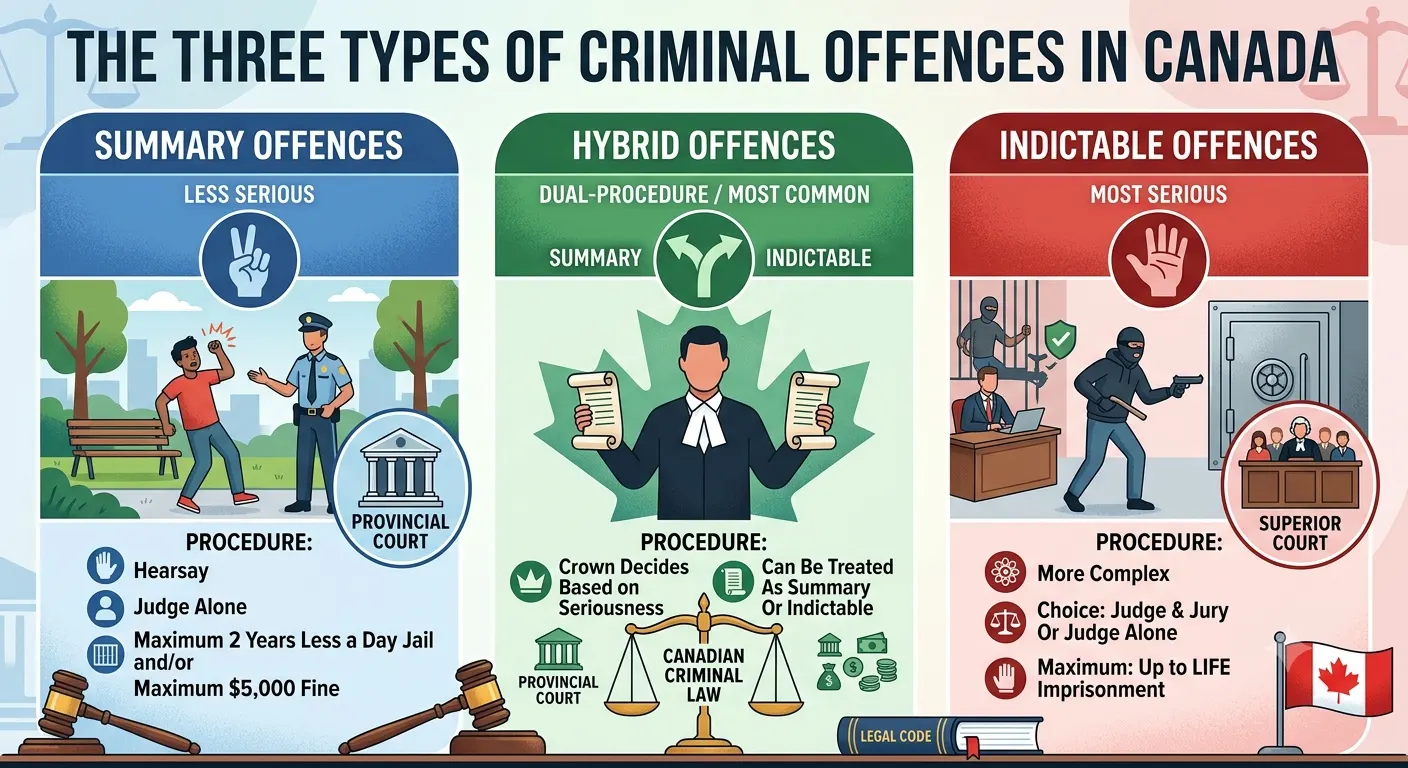
Canada groups every criminal offence under the Criminal Code into three categories, summary offences, indictable offences and hybrid offences and the category matters a great deal if you are an Australian planning to visit, study, work or migrate to Canada because even a minor charge back home can be treated as a serious offence under Canadian immigration law and lead to a refusal at the border or a rejected visa application.
Why This Topic Matters If You Are Moving From Australia
Australia and Canada share a similar legal system, yet the two countries do not classify offences the same way.People are genuinely surprised to learn that an old drink driving charge, a minor assault from a bar fight years ago or even a shoplifting caution can be enough to have their eTA or study permit application flagged. Many users describe assuming that because a charge felt minor at the time, or because it did not lead to jail time, it would simply be overlooked. The common thread across these discussions is that Canadian officers look at the maximum possible penalty under Canadian law, not how the matter was actually resolved back home, and this catches a lot of travellers by surprise.
Connect with RCIC licensed consultants
The Three Types of Criminal Offences in Canada
1. Summary Offences
Summary offences are the least serious category under the Criminal Code. They are handled quickly by a judge alone in provincial court, with no jury involved. Typical examples include causing a disturbance, trespassing at night or minor mischief. Most summary offences carry a maximum penalty of a fine and up to two years less a day in jail, although sentences of this length are rare in practice.
2. Indictable Offences
Indictable offences are the most serious crimes recognised in Canada. They cover things like robbery, drug trafficking, aggravated assault and murder. Penalties can range from several years to life imprisonment, and some indictable offences carry a mandatory minimum sentence. A person charged with an indictable offence usually has more choice over how their trial proceeds, including whether it is heard by a judge alone or by a judge and jury.
3. Hybrid Offences
Hybrid offences, sometimes called dual procedure offences, make up the largest share of crimes
in the Criminal Code. The Crown prosecutor decides whether to proceed summarily or by indictment,
usually based on the seriousness of what happened and the accused person's history. Common examples
include assault, theft under five thousand dollars and impaired driving.
This category is the one that trips up most visa applicants, because Canadian immigration law
treats every hybrid offence as if it were indictable, no matter how the Crown actually chose to prosecute it.
| Offence Type | Court and Trial | Typical Examples | Immigration Treatment |
|---|---|---|---|
| Summary | Judge alone, provincial court | Disturbance, trespassing, minor mischief | Usually admissible if it is a single offence |
| Indictable | Judge or judge and jury | Robbery, trafficking, aggravated assault | Treated as criminality or serious criminality |
| Hybrid | Depends on Crown election | Assault, theft under five thousand, DUI | Deemed indictable for admissibility purposes |
How This Affects Your Application to Enter Canada
When you apply for a Canadian visa, an eTA, a study permit, a work permit or permanent residence, an officer will compare your past charge or conviction against the closest equivalent offence under Canadian federal law. If that equivalent is classed as indictable, or as hybrid, you may be found criminally inadmissible to Canada under the Immigration and Refugee Protection Act. This can apply even if the matter happened years ago, and even if you were never actually sent to jail. A single indictable equivalent or two summary equivalents can be enough to trigger inadmissibility.
The good news is that inadmissibility is rarely permanent. Depending on how much time has passed and the nature of the offence, you may qualify for Deemed Rehabilitation, which happens automatically once the required years have elapsed. If you do not qualify automatically, you can apply for Criminal Rehabilitation, which is a more formal process that permanently clears your record for Canadian immigration purposes once approved. If you need to travel sooner, a Temporary Resident Permit can allow entry for a specific and time limited purpose while your rehabilitation application is prepared or still in progress.
Steps You Can Take If You Have a Past Charge
- Get a clear picture of exactly what you were charged with and how the matter was concluded, including any conditional discharge or diversion program.
- Work out the closest Canadian equivalent offence, since this is what actually determines your admissibility, not the label used in Australia.
- Check how many years have passed since your sentence was completed, since this determines whether Deemed Rehabilitation may already apply to you.
- Speak with a licensed immigration consultant before you submit any application, so any risk is addressed proactively rather than discovered at the border.
How to Check If Your Charge Is Summary, Indictable or Hybrid
If you already have a charge or conviction and you want to know which category it falls under, the fastest way is to look at the actual section of the Criminal Code you were charged under, not just the name of the offence, since the wording of that section will tell you how it can be prosecuted.
- Read your charge sheet or court documents carefully. Canadian court paperwork usually references a specific section of the Criminal Code, such as section 266 for assault. Looking up that section number, rather than relying on the everyday name of the crime, gives you the true legal classification.
- Check the wording used in the Criminal Code itself. A section that simply says an offence is punishable on conviction, without giving the Crown a choice, is a straight indictable or straight summary offence. A section that gives the Crown the option to proceed either summarily or by indictment is describing a hybrid offence.
- Look at how your matter was actually resolved. Your record or the disposition sheet may state whether the Crown elected to proceed summarily or by indictment. This detail matters for a domestic criminal matter, although for Canadian immigration purposes any hybrid offence is still treated as indictable regardless of that election.
- Compare a foreign charge against the closest Canadian equivalent. If your offence happened outside Canada, an immigration officer or consultant will match it against the nearest Canadian offence and classify it using that equivalent, not the label used in your home country.
- Get a professional opinion before you apply or travel. Classification can be genuinely difficult to work out on your own, especially when a foreign offence does not map neatly onto Canadian law. A licensed consultant or lawyer can review your court documents and confirm the classification in writing before you submit a visa application or head to the border.
Getting this classification wrong on your own can lead to an inaccurate assumption about your admissibility, so it is worth having it confirmed properly rather than guessing based on how the offence felt at the time.
FAQs
Canada groups every offence under the Criminal Code into three categories, summary offences, indictable offences and hybrid offences. Summary offences are the least serious and are handled by a judge alone. Indictable offences are the most serious and can carry a life sentence. Hybrid offences sit in between, and the Crown decides whether to prosecute them summarily or by indictment.
A single genuine summary offence will usually not make you inadmissible on its own. The concern arises with a single hybrid or indictable equivalent offence, or with two or more summary equivalents, since either scenario can trigger criminal inadmissibility under Canadian immigration law.
Impaired driving is treated as a hybrid offence under the Criminal Code. For immigration purposes, hybrid offences are deemed indictable regardless of how the Crown actually prosecuted the matter, which is why even a first time drink driving charge can lead to a refusal at the border.
Look at the specific section of the Criminal Code referenced on your charge sheet or court documents, since the wording of that section determines the classification, not the everyday name of the offence. If your charge happened outside Canada, it needs to be matched against the closest Canadian equivalent, and this is best confirmed by a licensed consultant.
Deemed rehabilitation happens automatically once enough time has passed since your sentence was completed, usually ten years for an indictable equivalent and five years for a summary equivalent, provided there is no serious criminality involved. Criminal rehabilitation is a formal application you submit to the Canadian government, and it is required when you do not qualify automatically or when your matter involves serious criminality.
In most cases you need to wait at least five years from the date you completed every part of your sentence, including any jail time, probation, fines and community service, before you can submit a criminal rehabilitation application.
It depends on how your record translates under Canadian law. If your only offence equates to a single summary conviction, you may still be considered admissible. If it equates to a hybrid or indictable offence, you will likely need to resolve your inadmissibility through a Temporary Resident Permit or criminal rehabilitation before your application can be approved.
GIEC Global works with you to identify the correct Canadian equivalent for your offence. Our team prepares supporting documentation, reviews your court records and sentence history, and works directly with our RCIC registered consultants to give you a clear and honest assessment before you apply or travel. Book a free consultation and we will walk you through your options step by step
You will generally need your charge sheet or court disposition, details of your sentence and the dates it was completed, and any police clearance certificates. Having these ready allows a consultant to identify the correct Canadian equivalent offence and advise you on the right pathway before you apply or travel.